


There is a question quietly circulating among AI researchers and engineers that has become something of an unofficial benchmark. It is deceptively simple:
“The car wash is 40 meters from my home. I want to wash my car. Should I walk or drive there?”
The correct answer is obvious to any human: drive. You need the car to be at the car wash. Walking there leaves your car sitting dirty in the driveway.
Yet in February 2026, when AI researcher Itamar Golan posted this question to every major model on the market, the majority failed. Not because the question was ambiguous. Because the models were not actually reasoning.
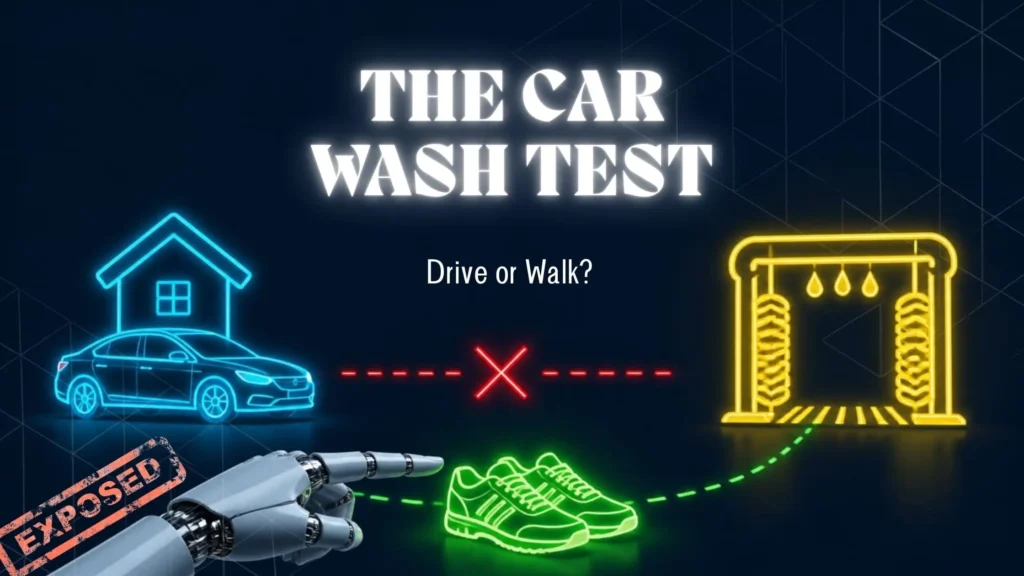
Table of Contents
What the Research Found
Opper AI ran the most rigorous version of this test, putting 53 models through their paces with no system prompt, a forced choice between “drive” or “walk,” and a required reasoning explanation. On a single run, 42 out of 53 models got it wrong.
The wrong answers were all variations of the same logic: “50 meters is a short distance. Walking is more efficient, saves fuel, and is better for the environment.” Correct reasoning. About the wrong problem entirely.
The models fixated on the distance and completely missed that the car itself needed to get to the car wash. The models were not thinking about the car; they were statistically predicting the most reasonable-sounding advice for a short trip.
Consistency tests made the picture worse. Of the 11 models that passed on a single run, only 5 passed consistently across 10 repeated runs: Claude Opus 4.6, Gemini 2.0 Flash Lite, Gemini 3 Flash, Gemini 3 Pro, and Grok-4. Every Llama and Mistral model failed entirely.
Why This Happens
LLMs do not reason about physical reality; they predict likely word sequences. When training data associates a short distance with “should I drive or walk,” the statistical pattern points toward “just walk.” The result is confident, and completely wrong.
This is a modern instance of the Frame Problem, a classic AI challenge identified in 1969. The model struggles to understand which variables change (the human’s location) and which implicitly must also change (the car’s location) to achieve the stated goal.
What It Means
The Car Wash Test is not a trick question. It requires no specialized knowledge. A child who has been to a car wash would answer it correctly in seconds.
What it tests is whether a model actually builds a mental model of the situation, tracking the car as an object with a location that must change to achieve the goal, or whether it simply maps input tokens to statistically probable output tokens.
The Car Wash Test is a reminder that reasoning in AI is still distinct from understanding. While models are getting better at solving complex math and coding problems, they can still trip over the basic logic of daily life.
Before you trust an AI with your business decisions, your customer communications, or your workflows, it might be worth asking it about a car wash first.
Want to learn more about AI? Take the Artificial Intelligence Course.
